
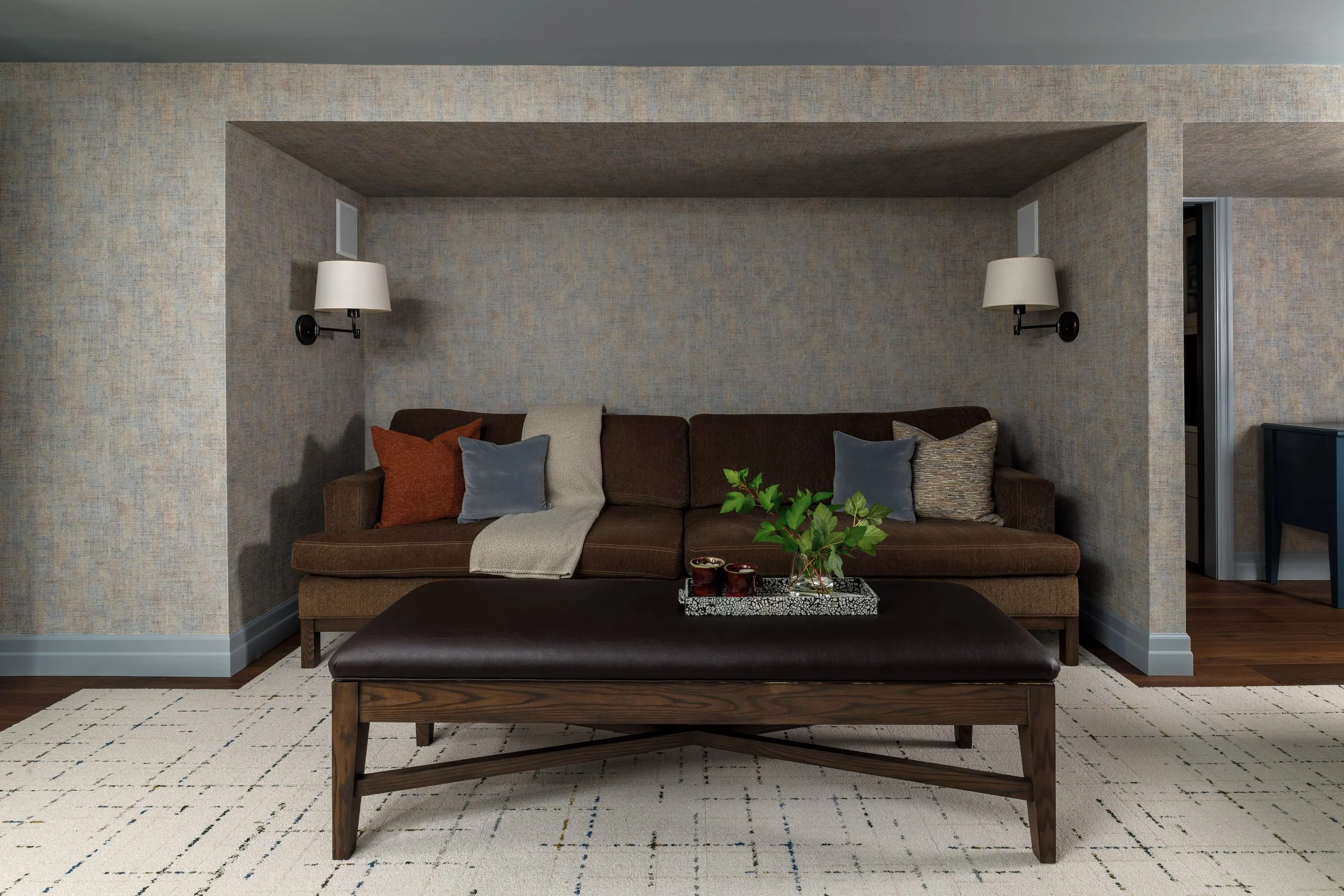
The wallcovering wraps into the alcove ceiling, so the whole nook reads as one finished space.
We recently finished a basement rec room for repeat clients. The furniture was in, the lighting was nearly there, and the room was perfectly pleasant. Then the wallpaper went up, and it became a completely different space. Same room, same sofa, same chair. It went from a basement to the place everyone wants to spend the evening.
That is what wallpaper does that paint can't. Paint changes the colour of a room. Wallpaper changes how it feels: the texture catches the light, the walls stop reading as flat boxes, and the whole space feels finished and cozy.
It is also one of the easiest things to get wrong. Here is how I think about it.
Where wallpaper earns its place
Some rooms benefit more than others.
Powder rooms. Small, enclosed, and visited by every guest. This is the place to be bold, because you are in it for a few minutes, not a whole evening.
Basements. Lower ceilings, smaller windows and plain drywall can make a basement feel like an afterthought. A textured paper adds warmth and depth that paint alone rarely manages.
Dining rooms. You sit still in a dining room, often after dark, so the walls are noticed. A paper with some sheen comes alive in candlelight.
Primary bedrooms. Where there is often little in terms of architectural interest, a paper gives the room life and a sense of calm that a painted wall can't.
Ceilings. The most overlooked surface in the house. Papering a ceiling makes a room feel considered from every angle.
Texture or pattern
This is the first decision, and it changes everything that follows.
Textured papers, like grasscloth, linen weaves and woven looks, work quietly. They add depth without competing with the art, the fabrics or the furniture. They suit rooms where you want warmth more than drama, and they are forgiving when a room has a lot going on.
Patterned papers make a statement. They work best when the rest of the room is edited to let them lead. In a room full of colour and pattern already, a patterned wall becomes intense.
In the rec room, we chose texture. The room already had a lot to hold, and what it needed was warmth, not another thing to look at.
Get the scale right
A pattern that looks lovely on a sample can overwhelm a small room, or disappear in a large one. Small, tight patterns can read as busy from across a room. Large patterns need wall space to show the full repeat.
I always want to see a large sample, in the room, at different times of day. A small swatch in your hand tells you almost nothing about how a paper will feel across a whole room.
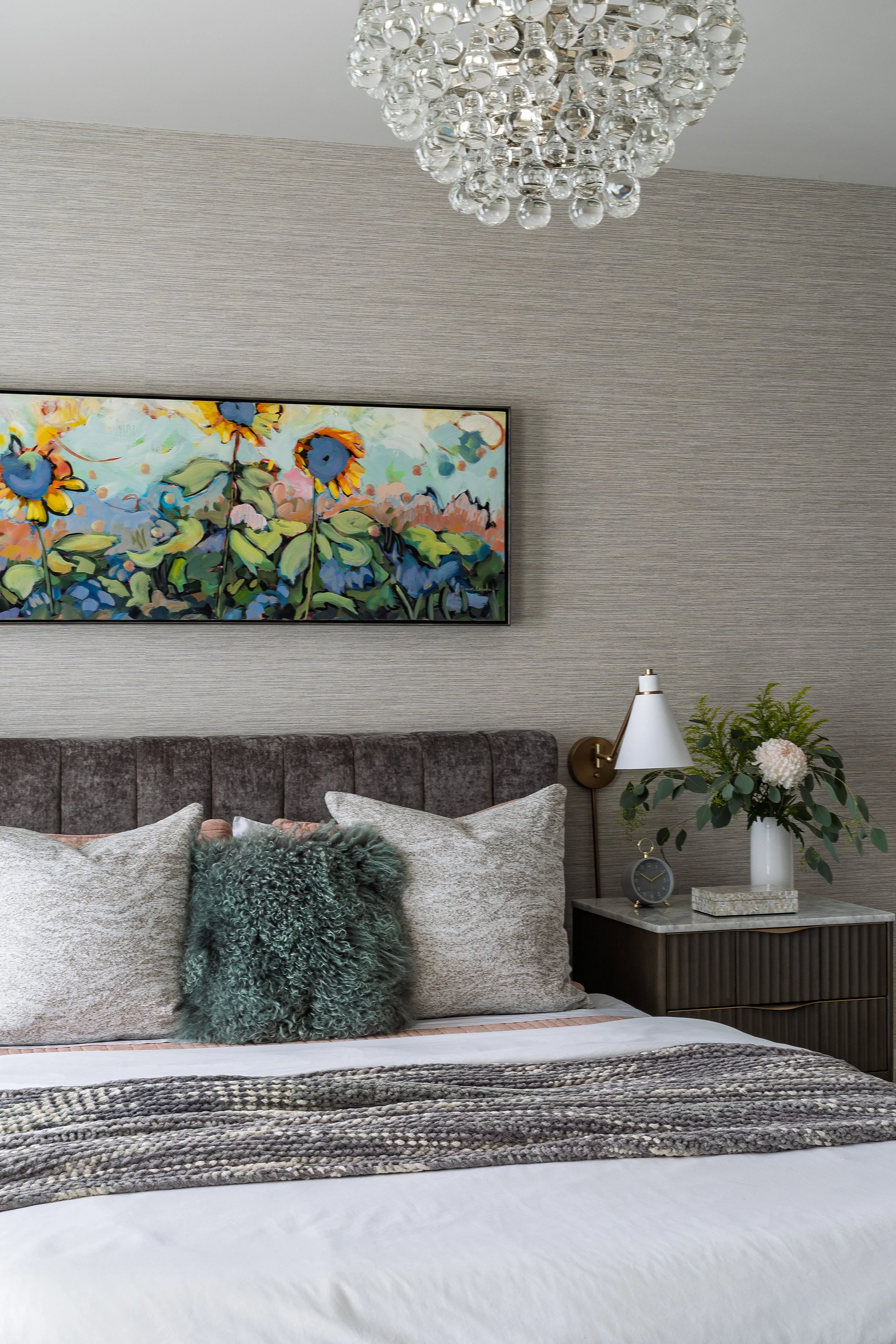
A quiet texture behind the bed lets the art do the talking.
One wall or the whole room
A single feature wall can work, but it often looks like a decision half made. In most rooms, I would rather paper all four walls in something quieter than one wall in something loud. The room feels wrapped, rather than having one wall that doesn't match the others.
The one exception I might make is a mural wallpaper, well placed. An entry hall or a headboard wall can carry a single mural beautifully, because it is meant to be the focal point. But the paint on the surrounding walls has to closely match the mural's colour saturation. If the mural is soft and muted, the paint must be too. A bright white or a mismatched tone next to it makes the mural look like a sticker on the wall rather than part of the room.
Don't leave the trim and ceiling white by default
This is the detail I see missed most often. The paper goes up, and the baseboards, door casings and ceiling stay the builder's white they have always been. Against a warm or textured paper, bright white trim looks stark and unfinished. It outlines every edge of the room and pulls your eye away from the walls.
The trim and ceiling are part of the paper decision, not an afterthought. Sometimes that means painting the trim to pick up a tone in the paper, so the walls read as one continuous surface. Sometimes it means a ceiling colour a few shades softer than the walls, or carrying the paper right up and over, as we did in the rec room alcove. White can still be the right answer, but it should be a white chosen for that paper, not the one that happened to be there.
In the rec room, the baseboards were painted to sit quietly with the wallcovering rather than frame it. It is a small change, and it is a big part of why the room feels finished.
The installer matters as much as the paper
This is the part most people underestimate. Beautiful paper badly hung looks worse than good paint. Visible seams, mismatched patterns at the joins, bubbles and peeling corners undo the whole point.
Textured and natural papers are particularly unforgiving. Grasscloth, for example, shows colour variation between panels and needs an installer who knows how to plan the layout so it reads as one surface.
It is the reason I always arrange wallpaper installation myself, rather than leaving it to the client to find someone. I work with installers whose work I know and trust. It is a small part of a project, and one of the most visible.
Worth the commitment
Wallpaper asks more of you than paint. It costs more, it takes longer, and it is harder to replace if you change your mind. But when it is chosen well and hung properly, it gives a room something nothing else can: a sense that every surface was considered.
As the evenings get longer and we spend more time indoors, I find myself noticing walls more. If there is a room in your home that feels pleasant but unfinished, it may not need new furniture at all. It may just need the walls to do more of the work.
At Yassein Interiors in Whitby, Ontario, I work with homeowners across the GTA and Durham Region on full-service decorating projects, where wallpaper is often one of the layers that brings a home together. When it is part of the plan, I take care of it from selection through installation.
Gaddah Yassein is an interior decorator and the founder of Yassein Interiors, a boutique full-service decorating studio based in Whitby, Ontario. She serves clients across the GTA, Durham Region, and Northumberland County.