
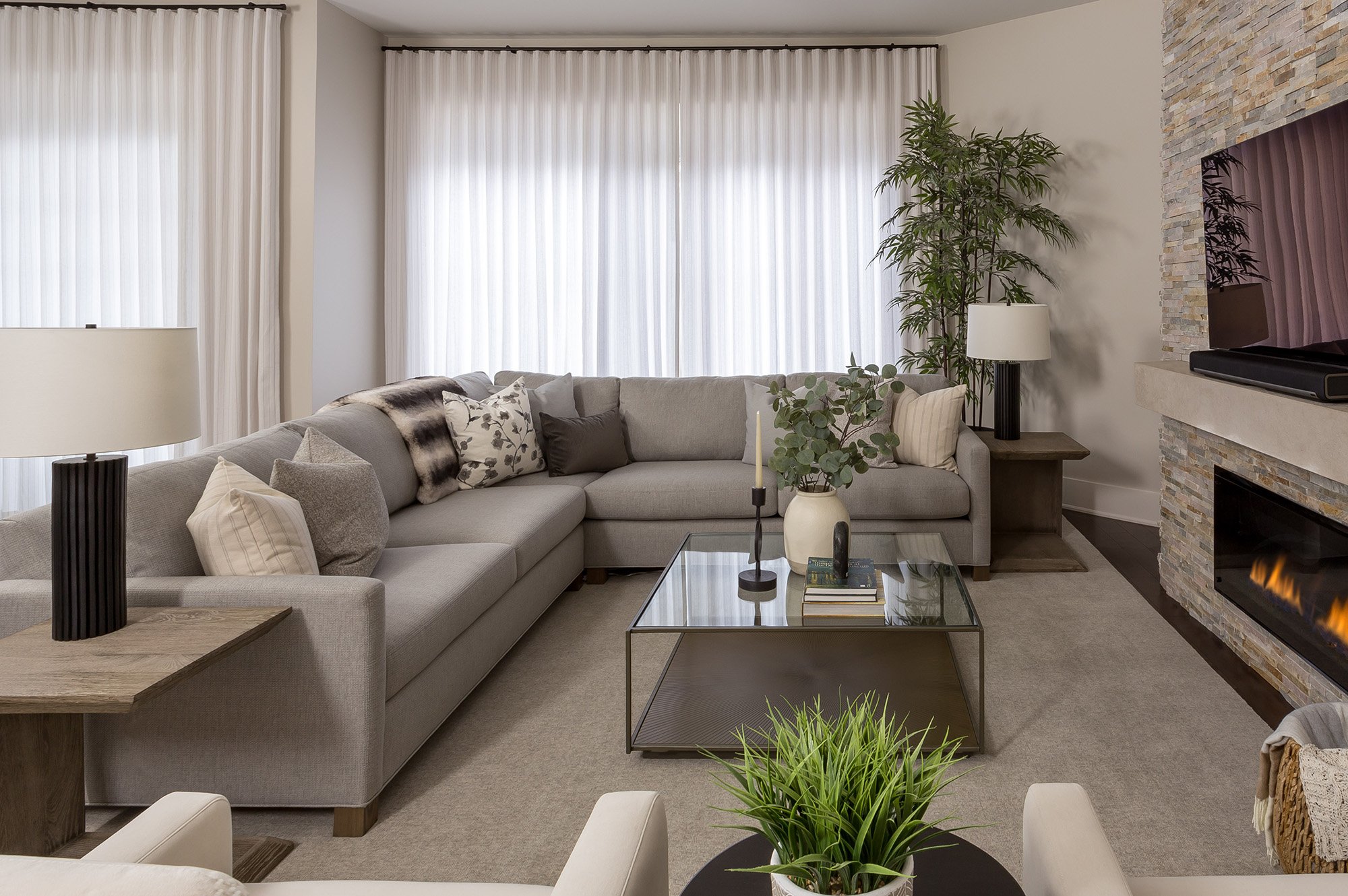
Relaxed Neutral living room — sectional sofa and glass coffee table anchored by area rug, interior decorating by Yassein Interiors
I have walked into hundreds of homes over the course of my career. Beautiful homes, builder-basic homes, homes that have been professionally staged and homes that clearly haven't been touched in years. And in each one, within the first thirty seconds, there is something I register before I consciously register anything else.
It isn't the colour on the walls. It isn't the furniture style. It isn't even whether the space is clean or cluttered. What I notice first — always — is whether the room feels balanced.
Not symmetrical. Not styled. Balanced. There's a difference, and it matters enormously.
When a room is balanced, you feel it in your body before you see it with your eyes. You cross the threshold and something in you settles. The space makes sense. You know instinctively where to sit, where to look, how to move through it. When it isn't balanced, you feel that too — a low-grade restlessness, a sense that something is slightly off, even if you couldn't say exactly what. I've had clients describe it to me as a room that "doesn't feel right" or "never feels finished, no matter what I add." Usually, they've been adding the wrong things, because the underlying problem isn't decor. It's space planning.
What Off-Balance Actually Looks Like
The most common culprit I see is furniture pushed against the walls.
It seems counterintuitive — pulling everything to the perimeter should create more space in the centre, right? In practice, it creates the opposite of what you want. The furniture becomes a series of disconnected objects lining the edges, the middle of the room becomes an awkward empty void, and any sense of intimacy or intention disappears. It is the interior equivalent of a dinner party where everyone stands at the edge of the room instead of gathering around the table.
Great space planning works from the inside out, not the outside in. You start by defining the activity — how will people actually sit in this room? Where does the conversation happen? Where does the eye want to land? — and then you arrange the furniture to support that, regardless of where the walls are. A well-grouped sofa and chairs floating in the centre of a room, anchored by a rug, will almost always feel better than the same pieces pressed to the perimeter.
The second thing I see consistently is scale. A rug that is too small is one of the fastest ways to destabilize a room. If your rug barely reaches the front legs of your sofa, the entire seating grouping looks like it is hovering, unmoored. A properly scaled rug — one that all four legs of every major piece sit comfortably on, or at minimum where the front two legs of each piece connect to it — acts like a floor plan within the floor plan. It tells the room where its centre of gravity is.
These are not expensive fixes. They don't require new furniture or a renovation. They require someone to look at the room with fresh eyes and ask the right questions about how the space is actually being used versus how it has simply ended up arranged over time.
When I walk into a room that doesn't feel balanced, I don't see a problem. I see a room that hasn't been listened to yet.
That is the first thing I always notice. And it is almost always the first place I start.
Yassein Interiors is based in Whitby, Ontario, and works with clients across the GTA and Durham Region. If your rooms feel unbalanced or incomplete, a fresh professional perspective is often all it takes.