
The Rug-Size Mistake That Shrinks Every Living Room
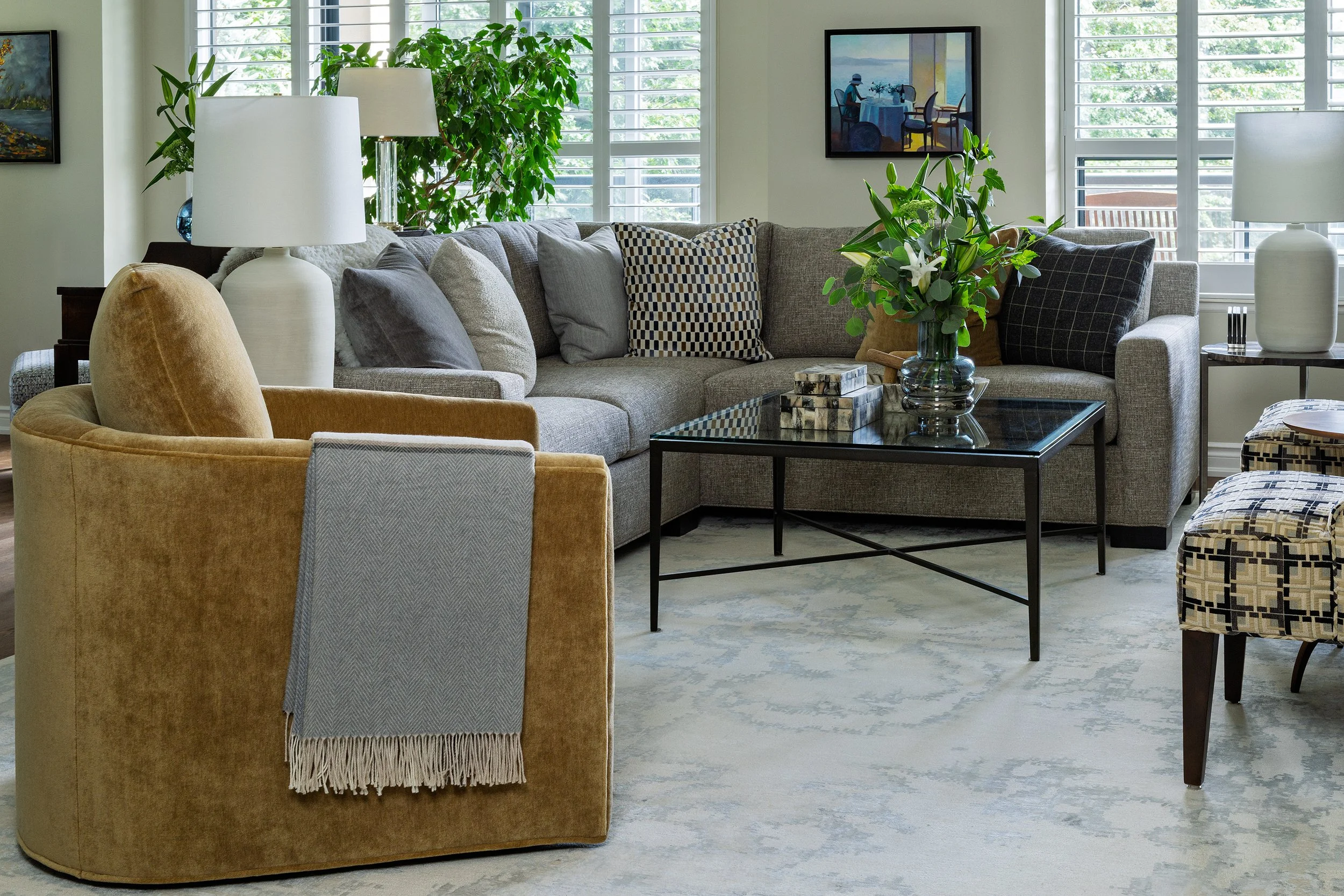
If your living room feels off, it's probably the rug.
Not the colour. Not the pattern. Not even the material. Almost every time I walk into a home for a first consultation and the seating area feels smaller than it should, or slightly adrift, the problem traces back to a rug that's too small for the space it's meant to anchor.
It's an easy mistake to make. Rugs are expensive, standard sizes jump in large increments, and the size that looks "about right" in a showroom almost never accounts for how much floor a real seating arrangement actually covers. So people size down — to save money, to avoid an awkward in-between measurement, to fit a size they've already found in a colour they love. The room pays for it every day after.
The Rule Everyone Skips
The minimum standard is simple: the front legs of every major piece of furniture — sofa, chairs, anything anchoring the seating group — should rest on the rug. Not hover near it. Not sit an inch or two off the edge. On it.
This is the floor, and most rooms fall short of even this minimum. But it's still only the floor. The standard I actually design toward is better: all four legs of every piece, resting on the rug. When a rug does this, it stops being a decorative layer and starts doing what a rug is actually for — defining the boundary of a space within a space, telling the eye and the body where the room's centre of gravity sits.
When furniture floats half on, half off a rug that's too small, it reads as unmoored — a grouping of separate objects rather than a considered arrangement. When furniture sits entirely off the rug, on bare hardwood, it reads as unfinished, no matter how good the individual pieces are. I see this constantly in homes with beautiful furniture that still feels like it hasn't quite arrived.
What Actually Fits
The sizes people default to — 5x8, 6x9 — are almost always too small for a living room seating arrangement, even a modest one. They're sized for smaller spaces: a bedroom, a reading nook, a room where the rug is meant to sit under one or two pieces rather than anchor a whole grouping.
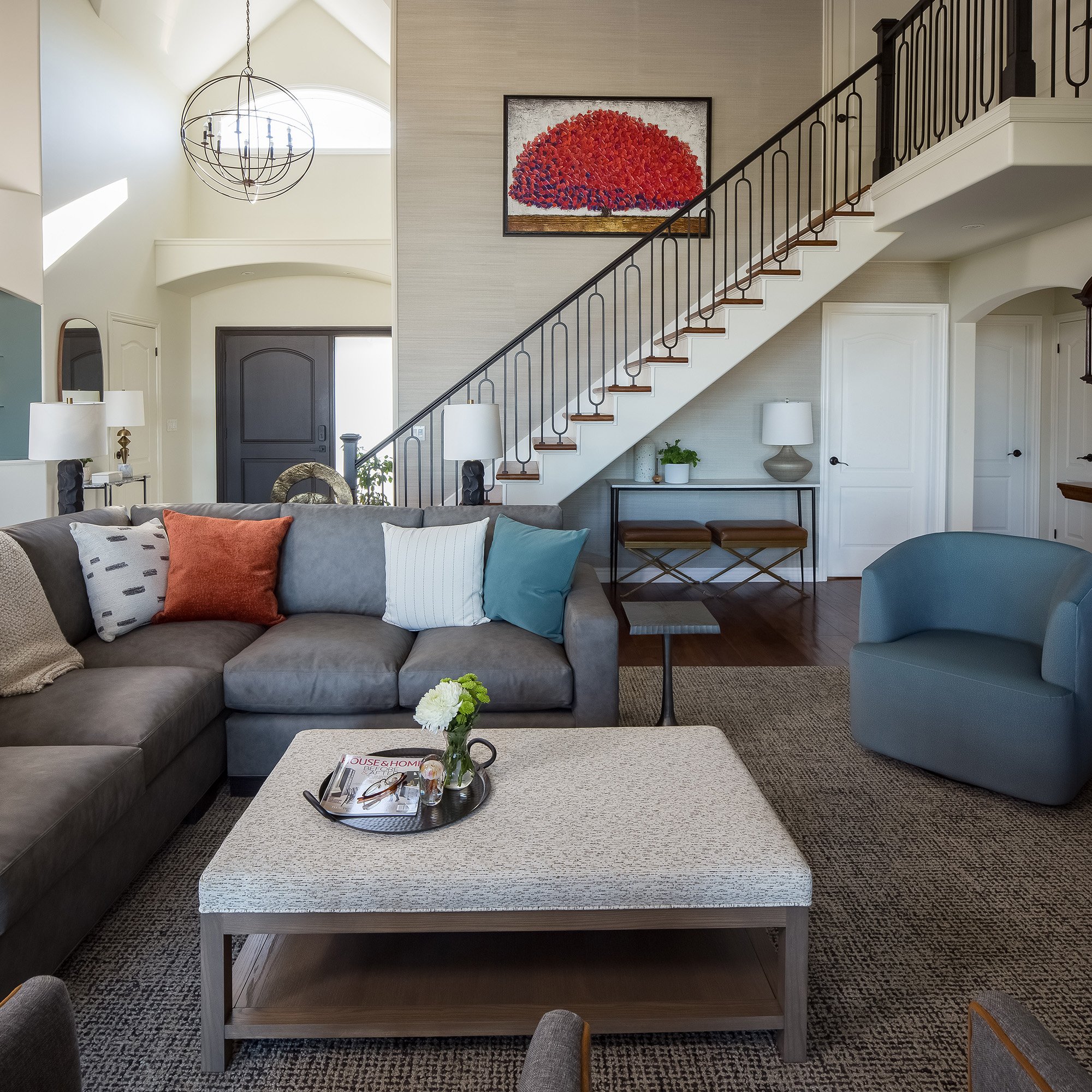
For a standard living room with a sofa and two chairs, 8x10 is usually the real starting point, and larger rooms often call for 9x12 or bigger. The rug needs to extend far enough that a coffee table, the front two-thirds of a sofa, and the front legs of flanking chairs can all sit within its boundary with room to spare — not just barely touching the edge.
This is where budget and proportion collide, because larger rugs cost meaningfully more. But an undersized rug isn't a compromise that saves money quietly — it's a compromise that shows, every day, in a room that never quite settles.
A Note on Layering
You'll see layered rugs — a jute base with a smaller patterned rug on top — recommended often online. I don't specify this. Beyond the aesthetic rarely earning its keep, a layered rug creates a second edge for someone to catch a foot on, and and in the homes I work in across Whitby and the GTA — often full of grandkids, guests, and daily traffic — that's not a trade-off worth making for a decorative effect. One well-scaled rug, sized properly, solves the problem layering is trying to paper over.
Why This Matters More Than People Expect
A rug is one of the few elements in a room that functions almost entirely below eye level, which is probably why it gets underweighted in most people's decorating priorities. But the eye reads a room from the floor up as much as it does from eye level out. A properly scaled rug is doing structural work — it's a floor plan within the floor plan, the same way I think about drapery mounting height doing structural work on the vertical plane of a room.
These two decisions — how drapery is specified and how a rug is scaled — are the two most common places I see a well-furnished room undercut itself. Neither mistake is about taste. Both are about proportion, and proportion is almost always fixable without buying anything new — just by getting the scale right the first time.
Gaddah Yassein is an interior decorator and the founder of Yassein Interiors, a boutique full-service decorating studio based in Whitby, Ontario. She serves clients across the GTA, Durham Region, and Northumberland County. If you're thinking about a project — condo or otherwise — we’d love to talk.