
Custom Drapery: A Decorator's Guide for Forever Homes

Floor-length custom drapery framing a sliding glass door, Toronto Ontario interior design
Drapery is the most undervalued decision in residential decorating. Most people treat it as a finishing touch — something to figure out once the furniture is in, the walls are painted, and the room is otherwise "done." By then, the decision becomes about choosing fabric to coordinate with what's already there. The drapery becomes a softening note, not a structural element.
But in the rooms that feel finished — the ones where the proportions read right, the light feels considered, and every element seems to belong — drapery wasn't an afterthought. It was planned in tandem with everything else: fabric weight, mounting position, panel width, treatment style. All of it considered alongside the upholstery, the rug, the lighting, the wall colour.
Custom drapery isn't about luxury. It's about getting the fundamentals right — and those fundamentals are almost impossible to achieve with ready-made panels off a shelf. Here's what I look at when I specify drapery for a project.
Length and Mounting
The first decision is length. And the most common mistake — the one I see in nearly every home I walk into for a first consultation — is drapery that floats above the floor. Six inches above, eight inches above, sometimes more. The reasoning is usually practical: ready-made panels come in standard lengths, the closest length was too short or too long, nobody wanted to hem. The result is always the same. The window looks shrunken, the ceiling looks lower, and the room feels less considered than it should.
Drapery should kiss the floor. Or break against it slightly — a half-inch to one-inch break, where the bottom of the panel just touches and pools gently. Never more than a half-inch above. A gap bigger than that between the bottom of the drape and the floor diminishes the entire room.
Mounting matters as much as length. Where you place the rod determines how the eye reads the window. Mount the rod at the top of the window frame, and the window looks the size that it is. Mount the rod at the ceiling — or close to it — and the window stretches. The eye reads the entire wall as a window. The ceiling height feels generous. The room feels taller.
This is one of the simplest improvements you can make in a room, and it costs nothing extra to do it right. Custom drapery makes it possible because the panel length is made to your room — not to a manufacturer's nearest approximation.
Fullness and Fabric
The second decision is volume. How much fabric belongs in the panel.
A drape needs to be at least twice the width of the window opening to look full when it's closed — and even when it's open, those gathered panels at either side of the window should look generous, not skimpy. Ready-made drapery rarely comes in the width you actually need. You end up with thin panels that look strained when closed and dwarfed by the window when open. Often extending the width of the panels beyond the window frame is desirable. This gives the illusion of a larger window, and can create the illusion of symmetry when the window is off centre.

Pinch pleat drapery and valance in a living room with orange area rug
Fabric weight is the other half of the volume question. A drape that hangs beautifully in linen will not hang the same in cotton, in silk, in velvet, or in a synthetic. Each fabric has its own drape — the way it falls, the way it gathers, the way it catches light. A heavy linen will hold a clean pinch pleat and drop straight to the floor. A lightweight cotton will swing slightly and need an interlining to settle. A silk will reflect every change in light and require careful lining choices to behave.
This is where ready-made drapery falls down most often. The fabrics are chosen for cost and durability, not for hang. The lining is usually a thin polyester that adds no weight or body. The panels look flat. They never quite settle.
Custom drapery lets you specify everything: the face fabric, the lining, whether to add interlining for body, whether to weight the hem. These small choices add up to the difference between a drape that feels intentional and one that feels like an afterthought.
Treatment Style
The third decision is the treatment — how the panel attaches to the rod, how it gathers, how it hangs. This is the most visible decision, and the one most people don't think about until they're looking at finished work.
Pinch pleat is the classic. The top of the panel is gathered into evenly spaced pleats — usually three folds — that create a clean, tailored hang. The pleats sit consistently from one panel to the next. It's a treatment I specify often because it works in almost any room — traditional, transitional, modern. It reads as considered.
Ripple fold is the modern alternative. Instead of pinches, the panel attaches to a track in a continuous wave pattern that falls in soft, regular curves. The hang is more relaxed, the look more contemporary. It works beautifully in rooms with clean lines, minimal hardware, and a quieter overall aesthetic.
Grommet panels are the most casual — large metal rings punched into the top of the panel that slide directly onto the rod. Their main advantage is requiring less fabric than other treatments. Their disadvantages are bigger than they look: the grommets bind against the rod and are harder to open and close than they appear, and the panels need constant adjustment to hang evenly. They had their time but I rarely specify them — the visible hardware reads as inexpensive, and the function doesn't deliver.
Inverted pleat — sometimes called euro pleat — is similar to pinch pleat but with the pleats falling behind the panel rather than in front. It produces a cleaner, more minimal face. Beautiful in modern rooms, sometimes a touch too clean for traditional ones. One disadvantage is that they don’t always stack as cleanly when opened compared to a pinch pleat.
The treatment isn't just decorative. It changes how the drape moves, how it stacks back when open, how much rod length you need to clear the window when the panel is pulled aside. These are practical decisions that affect how the drapery functions every day — not just how it looks.
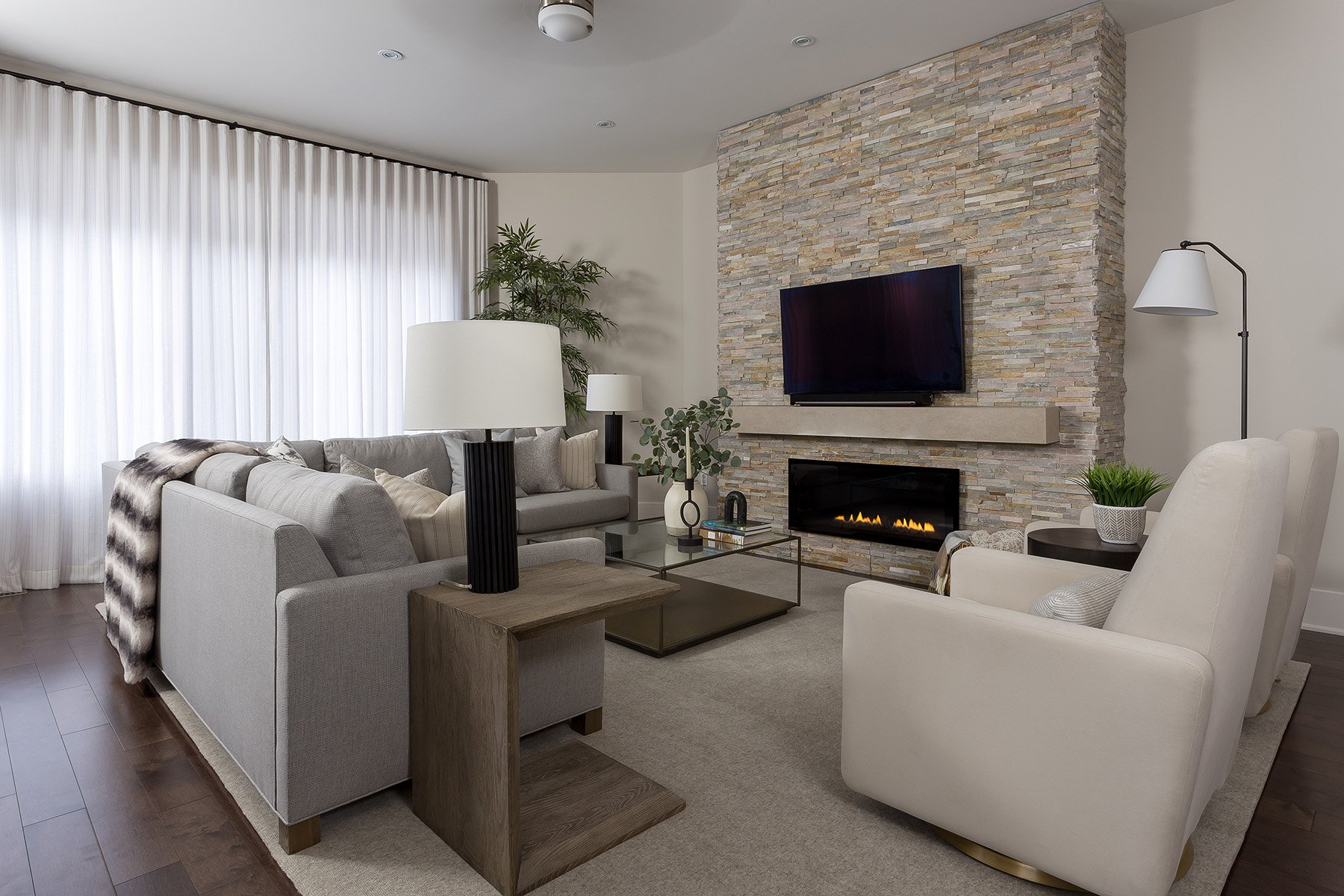
Ripple fold sheer drapery in a living room with a stacked stone fireplace wall
Drapery in Context
When I specify drapery for a project, I'm not making one decision. I'm making a dozen — length, mounting height, fullness, fabric, lining, treatment style, hardware, hem detail — and each of those decisions is informed by every other choice in the room. The wall colour. The light direction. The proportion of the window to the furniture. The function of the space.
This is why drapery is hard to get right without help. The decisions are interlocking. Choose the wrong fabric and the treatment falls flat. Choose the wrong treatment and the fabric does too much work. Mount the rod in the wrong place and even the most beautiful panels will detract from the room.
It's also why ready-made drapery almost never feels right in a forever home. Not because it's cheap — though it usually is — but because every decision has been made for you in advance, generically. The width that fits the warehouse. The length that covers the most standard windows. The fabric that survives shipping. The treatment that requires no tailoring. None of it is wrong; none of it is right for your room either.
Custom drapery is the alternative. Every panel made to your measurements, in fabric chosen for how it will hang in your light, with a treatment chosen for the way you actually want the room to feel.
It's a small detail. It does an enormous amount of work.
Gaddah Yassein is an interior decorator and the founder of Yassein Interiors, a boutique full-service decorating studio based in Whitby, Ontario. She serves clients across the GTA, Durham Region, and Northumberland County. If you're thinking about a project — condo or otherwise — we’d love to talk.